
 admin
admin  Blitz
Blitz  Backlinks Hub
 Coomer.su: What It Is, How It Works, and Whether It Is Safe

If you have searched for Coomer su, you may be trying to understand what the website is, why it appears in discussions about creator content, or whether the domain is safe to visit. The short answer is that Coomer.su became known as an unofficial archive that republished material associated with subscription-based creator platforms.
That description alone, however, does not explain the serious concerns surrounding the site. Questions about copyright infringement, creator consent, malicious downloads, unreliable mirror domains, privacy, and adult content make it significantly different from an ordinary media-sharing platform.
The original domain also appears to have experienced availability and domain-status changes. As a result, people searching for it may encounter inactive pages, security warnings, unofficial mirrors, misleading redirects, or sites attempting to imitate the original service.
This guide explains what Coomer.su was, how sites of this type generally operate, why the domain may not work, and what users should know about its safety and legal risks. It does not link to the platform or recommend using unofficial copies.
What Is Coomer.su?
Coomer.su was an online indexing and archiving website associated primarily with adult creator content. It reportedly collected posts and media connected to subscription platforms and displayed them outside their original paid environments.
Unlike legitimate subscription services, Coomer.su was not the original publisher of most of the material associated with it. It functioned more like an unofficial repository where imported or user-submitted content could be organized by creator, service, or post.
This distinction matters. A legitimate creator platform normally establishes a direct relationship between the creator, the platform, and the paying subscriber. It may provide payment processing, account security, content controls, moderation procedures, and formal copyright-reporting systems.
An unofficial archive may reproduce the same material without preserving those protections or proving that the creator authorized its distribution.
For that reason, Coomer.su should not be confused with an official creator marketplace, social network, or licensed content service.
What Type of Content Was Associated With Coomer.su?
The website was primarily associated with content originating from paid or membership-based creator services. This reportedly included:
- Images and video posts
- Creator profile information
- Text updates and captions
- Media attachments
- Archived subscription posts
- Adult-oriented material
- Public and subscriber-only content
A large portion of the site’s reputation came from explicit adult material. Therefore, it was not appropriate for children or workplace environments.
The exact source and authorization status of an individual file could vary. However, users should not assume that content is legal to redistribute simply because it appears on a publicly accessible website. Public availability does not automatically establish permission from the copyright holder.
How Did Coomer.su Work?

Coomer.su reportedly organized imported content into searchable creator profiles. A visitor could search for a creator and browse archived posts that had been added to the website.
Services of this type generally depend on submissions, automated imports, scraped information, or previously downloaded subscriber content. The files may then be stored directly or delivered through separate media servers and subdomains.
This structure can create several problems:
- The website may not verify whether an uploader owns the material.
- A creator may not know that their content has been copied.
- Media can remain available after deletion from the original platform.
- Download links may lead to external or unfamiliar domains.
- Copies can spread to additional mirrors even after a removal request.
Users also have no reliable way to determine whether a particular file was uploaded with permission, modified after upload, or bundled with something harmful.
Is Coomer.su Still Working in 2026?
The original Coomer.su domain does not appear to operate consistently as the archive users previously recognized. Current search results and technical discussions indicate that the service experienced domain changes, server errors, DDoS protection problems, and migration-related issues.
A GitHub issue from July 2025 reported that Coomer.su had shifted to Coomer.st, creating compatibility and cookie problems for third-party downloading software. More recent search results suggest the old domain may no longer be functioning normally.
This does not mean every similarly named address belongs to the same operator. When a well-known but unstable website changes domains, imitators often register lookalike addresses. These pages may copy branding or layouts to appear legitimate.
Therefore, searching for a “new Coomer domain” can create more risk than simply visiting an established website. A clone may exist primarily to display aggressive advertising, collect information, trigger downloads, or redirect users elsewhere.
Domain availability is also temporary information. A website that works today may disappear, redirect, or change ownership later.
Why Might Coomer.su Be Down?
There is rarely one publicly confirmed reason for every period of downtime. Possible explanations include:
Domain or DNS changes
A registered domain still needs active DNS configuration to direct visitors to its servers. If its DNS records are removed or changed, the domain may remain registered while becoming inaccessible.
Server overload
Large media archives consume substantial bandwidth and storage. Sudden traffic can overwhelm the infrastructure, causing slow loading, broken images, and failed video playback.
DDoS protection
DDoS protection systems may block or challenge requests that appear automated. Download managers that send many requests in a short period can trigger rate limits even when the user is not intentionally attacking the website.
Hosting or legal complaints
Hosting companies and service providers can suspend websites for policy violations, copyright complaints, illegal content, or security concerns.
Domain migration
The operators may move the service to a different top-level domain. Old links can then stop working or redirect unpredictably.
Maintenance or abandonment
Unofficial services do not always provide transparent status pages or reliable support. A long outage may indicate maintenance, but it can also mean that a project has been abandoned.
Users should not disable browser protection or antivirus warnings simply because they believe an outage is temporary.
Is Coomer.su Safe?
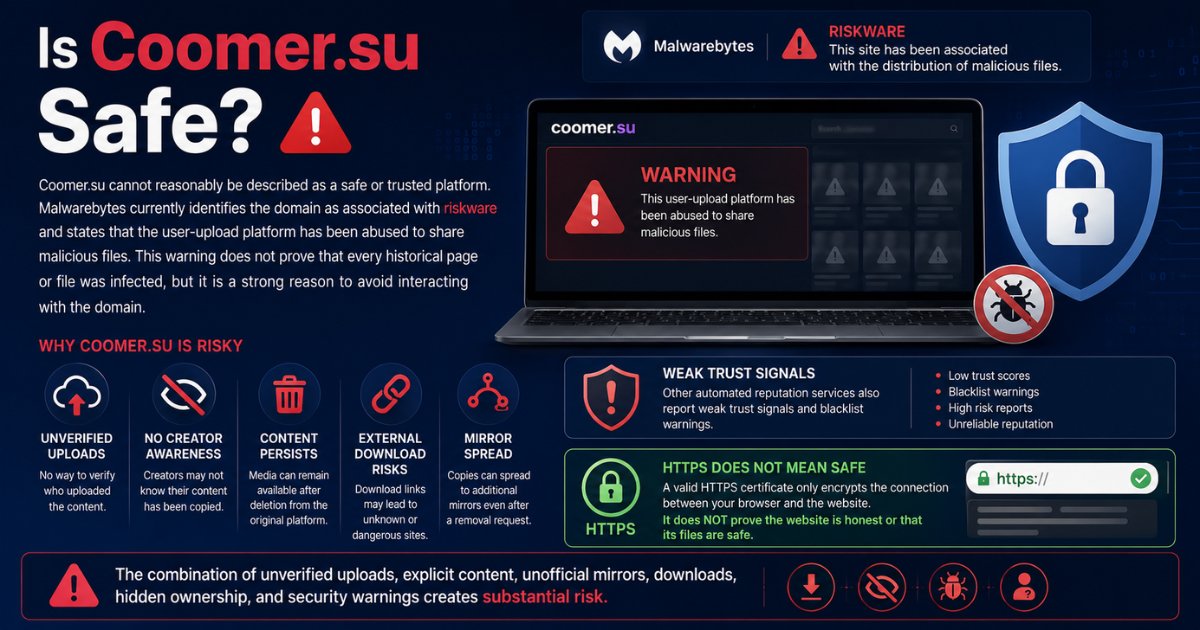
Coomer.su cannot reasonably be described as a safe or trusted platform. Malwarebytes currently identifies the domain as associated with riskware and states that the user-upload platform has been abused to share malicious files. This warning does not prove that every historical page or file was infected, but it is a strong reason to avoid interacting with the domain.
Other automated reputation services also report weak trust signals and blacklist warnings. Automated scanners can sometimes produce false positives, so no single score should be treated as absolute proof. In this case, however, the combination of unverified uploads, explicit content, unofficial mirrors, downloads, hidden ownership, and security warnings creates substantial risk.
A valid HTTPS certificate does not solve these problems. HTTPS encrypts the connection between a browser and a website, but it does not prove that the website is honest or that its files are safe.
Main security risks
Malicious downloads
A file can have a misleading name or extension. An apparent image or video download may contain an executable, script, archive, browser extension, or unwanted program.
Fake download buttons
Advertising networks on untrusted sites frequently display buttons that resemble the site’s real controls. Clicking one may open a phishing page or start an unrelated download.
Browser-notification abuse
A site may ask visitors to enable notifications before displaying content. Once permission is granted, it can send misleading security alerts and advertisements directly through the browser.
Redirect chains
Visitors may be sent through several unrelated domains. Each additional domain introduces another operator, advertising script, or tracking system that the user has not evaluated.
Clone websites
A copied version can imitate the original logo and interface while having no relationship with the earlier service.
Tracking and privacy exposure
A website can collect IP addresses, device information, approximate location, browser details, referral data, and interaction history. Private or incognito mode does not make a visitor anonymous.
The U.S. Federal Trade Commission recommends using updated security software and scanning new files to reduce malware risk. The safer decision here is simpler: do not download unknown content from an untrusted archive.
Is Coomer.su Legal in the United States?
There is no responsible universal yes-or-no answer covering every visitor, every file, and every jurisdiction. However, republishing or downloading protected creator content without authorization can raise serious copyright issues.
The U.S. Copyright Office explains that copyright protects original works once they are fixed in a tangible form. Photographs, videos, writing, artwork, and other digital creations can all receive copyright protection.
The Copyright Office also states that uploading or downloading protected works without the copyright owner’s authority can infringe the owner’s reproduction or distribution rights. Whether a specific activity constitutes infringement depends on facts including ownership, permission, licensing, and applicable legal exceptions.
Merely labeling a website an “archive” does not grant it permission to reproduce protected material. Similarly, paying for access to a creator’s original page usually gives the subscriber limited personal access—not ownership or a right to republish the content.
Copyright is not the only concern
Depending on the content and circumstances, other issues may include:
- Violation of a subscription platform’s terms
- Privacy violations
- Non-consensual distribution
- Right-of-publicity claims
- Harassment or impersonation
- Distribution of unlawfully obtained material
- Exposure of personal information
- Laws protecting intimate images
The legal consequences depend on location and the exact conduct involved. Anyone facing an actual notice, claim, or dispute should speak to a qualified attorney rather than relying on a general online guide.
Is Viewing Content the Same as Downloading It?
These actions are technically different, but that does not automatically make viewing risk-free or lawful.
Streaming or viewing content still requires data to be transmitted to a device and may create temporary cached copies. Downloading creates a more deliberate local copy and can make further reproduction or sharing easier. Uploading, reposting, selling, or distributing the material can introduce additional exposure.
The specific legal analysis depends on the source, authorization, jurisdiction, and user’s actions. It is safer to use the creator’s official page or another licensed platform instead of trying to interpret legal gray areas around an unofficial copy.
Does a VPN Make Coomer.su Safe?
No. A VPN can encrypt traffic between a device and the VPN provider and can mask the user’s public IP address from the destination website. It does not:
- Remove malware from a download
- Verify who operates a mirror
- Make copyright infringement legal
- Stop phishing pages from collecting submitted passwords
- Detect every malicious browser script
- Guarantee anonymity
- Protect a user who installs a harmful file
Marketing pages often present a VPN as a complete solution to unsafe websites. That is misleading. A VPN is a privacy tool, not proof that a site or download can be trusted.
What Should You Do If You Already Visited the Site?
Simply opening a page does not prove that a device has been compromised. There is no reason to panic, but sensible checks are appropriate.
If you did not download or install anything
- Close the website.
- Check whether it received browser-notification permission.
- Remove suspicious site permissions.
- Clear data associated with the domain.
- Make sure the browser and operating system are updated.
- Run a scan with reputable, updated security software.
If you downloaded a file
Do not open it again. Scan the file and the device using trusted security software. Delete the file if it is unnecessary or flagged. Check the browser’s download history to confirm what was saved.
If you entered a password
Change that password through the official website associated with the account—not through a link from the questionable page. If the same password was reused elsewhere, change it on those accounts as well. Enable multi-factor authentication where available.
If you entered payment information
Contact the card issuer using the number on the card or its official website. Review recent transactions and follow the issuer’s fraud instructions.
If pop-ups claim your device is infected
Do not call the displayed number or install the recommended program. Fake virus alerts are a common form of technical-support fraud. Close the tab and perform a scan using security software you already trust.
What Can Creators Do About Leaked Content?
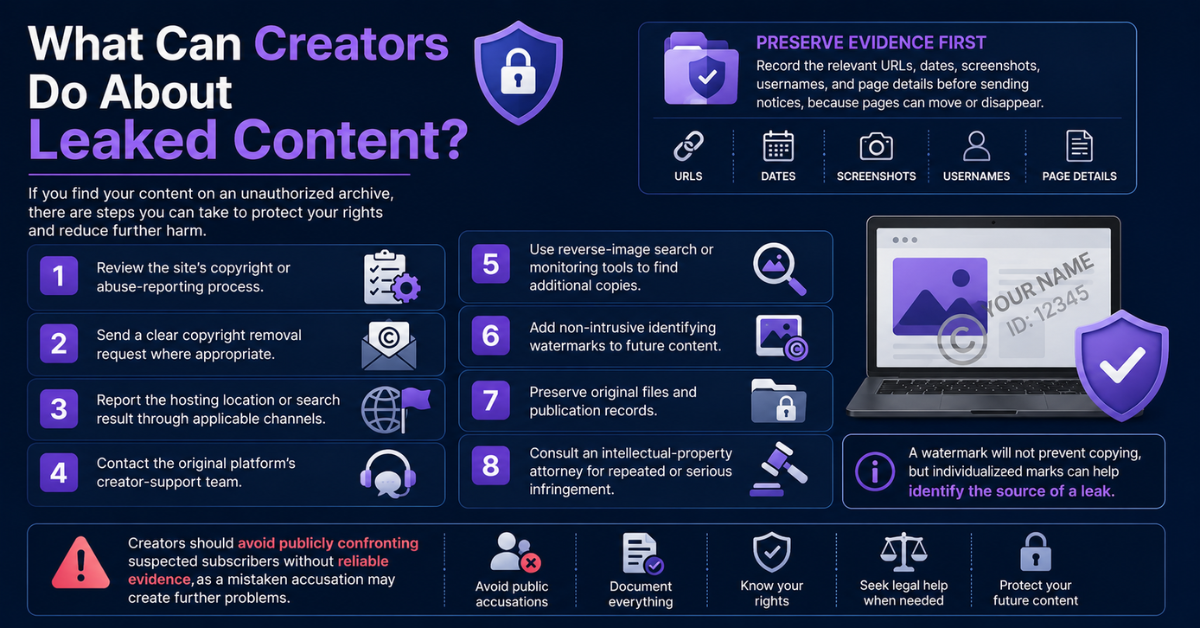
Creators who discover their work on an unauthorized archive should first preserve evidence. Record the relevant URLs, dates, screenshots, usernames, and page details before sending notices, because pages can move or disappear.
Possible next steps include:
- Review the site’s copyright or abuse-reporting process.
- Send a clear copyright removal request where appropriate.
- Report the hosting location or search result through applicable channels.
- Contact the original platform’s creator-support team.
- Use reverse-image search or monitoring tools to find additional copies.
- Add non-intrusive identifying watermarks to future content.
- Preserve original files and publication records.
- Consult an intellectual-property attorney for repeated or serious infringement.
A watermark will not prevent copying, but individualized marks can help identify the source of a leak. Creators should avoid publicly confronting suspected subscribers without reliable evidence, as a mistaken accusation may create further problems.
Legal and Ethical Alternatives to Coomer.su
A genuine alternative should not be another leak site. Replacing one unauthorized archive with another does not resolve the consent, copyright, or security problems.
Safer options include:
Official creator profiles
Use links published on the creator’s verified website or established social account. This reduces the chance of subscribing to an impersonator.
Authorized subscription platforms
Platforms such as Patreon, Ko-fi, Fanhouse, Fansly, and OnlyFans allow creators to publish under their own terms. Availability and content policies differ, so users should review each service directly.
Free promotional content
Many creators legally share selected images, trailers, livestreams, newsletters, and public posts. Free access does not need to mean leaked access.
Licensed media marketplaces
Some creators sell downloadable media through established storefronts. Check whether the seller owns the profile and whether the purchase includes personal-use or commercial-use rights.
Direct creator support
Tips, memberships, merchandise, and commissions allow followers to support the person who made the work.
The safest option is the one where the creator knowingly chose to publish the material and the platform has clear payment, privacy, and reporting procedures.
Why Do People Search for Coomer.su?
Search interest is likely driven by several different intentions:
- Former users checking whether the domain is down
- People investigating an unfamiliar address in browser history
- Users responding to a malware warning
- Parents reviewing a website accessed by a child
- Creators checking for copied material
- Researchers studying subscription-content piracy
- Users looking for a replacement domain
- People trying to understand the “Coomer” term
Not all searches indicate that someone intends to access explicit material. This is why a useful guide should answer safety, legal, status, and parental-control questions without directing visitors toward mirrors.
Is Coomer.su Appropriate for Minors?
No. The site has been associated with explicit adult content and should be treated as adults-only. More importantly, an unofficial archive may not apply the age-verification, content-labeling, and moderation standards expected from a regulated service.
Parents who notice the domain in browsing records should avoid relying only on punishment or silent blocking. A practical response includes:
- Explaining that the content is intended for adults
- Discussing consent and unauthorized sharing
- Enabling age-appropriate device restrictions
- Reviewing browser-notification permissions
- Checking for suspicious downloads
- Keeping operating systems and security tools updated
- Creating clear household rules for online purchases and adult sites
Monitoring should be proportionate and transparent. Secret surveillance can damage trust and may fail to teach safer online decision-making.
Frequently Asked Questions
What is Coomer su?
Coomer.su was an unofficial indexing and archiving website primarily associated with adult creator content copied or imported from subscription platforms. It was not an official creator marketplace.
Is Coomer.su safe to visit?
It cannot be recommended as safe. Malwarebytes identifies the domain as associated with riskware, and unofficial mirrors may introduce additional download, redirect, phishing, and privacy risks.
Is Coomer.su still working?
The original domain does not appear to operate consistently in its previous form. Reports have connected the project with domain changes, server problems, and DDoS protection. A similarly named site should not automatically be considered an official replacement.
Why is Coomer.su blocked?
A browser, network administrator, internet provider, or security product may block it because of explicit content, suspicious files, riskware reports, organizational policy, or domain reputation.
Is Coomer.su a virus?
A website is not itself the same thing as a computer virus. However, a domain can host or link to harmful files, malicious advertisements, phishing pages, and unwanted programs. Malwarebytes says the domain has been abused to share malicious files.
Can a VPN safely open Coomer.su?
A VPN does not make an unsafe website safe. It cannot verify downloads, prevent all tracking, remove malware, or legalize unauthorized access to protected content.
Is downloading from Coomer.su legal?
Downloading copyrighted work without permission may infringe the owner’s rights under U.S. law. The answer for a particular file depends on copyright ownership, authorization, licensing, legal exceptions, and jurisdiction.
Are Coomer.su mirror sites trustworthy?
A mirror should not be trusted merely because it copies the original site’s name or design. It may be operated by an unrelated party and could be created to distribute ads, collect data, or trigger harmful downloads.
What are safe Coomer.su alternatives?
Use official creator profiles, authorized subscription services, free promotional posts, or licensed marketplaces. Another unauthorized archive is not a genuinely safe or ethical alternative.
What should creators do if their content appears there?
Creators should preserve evidence, document URLs, submit appropriate copyright notices, contact the original platform, monitor for copies, and seek legal advice when the infringement is repeated or commercially damaging.
Final Verdict
Coomer.su became popular because it offered unofficial access to material associated with paid creator platforms. That convenience came with unresolved copyright, consent, privacy, and cybersecurity problems.
The original domain also appears unreliable, while the existence of copycat or replacement addresses makes searching for access even riskier. Security warnings should not be bypassed, and a valid SSL certificate or VPN should not be mistaken for proof of safety.
For users, the practical answer is to avoid downloads, mirrors, and unofficial replacements. For creators, documenting infringement and using formal removal channels is more effective than engaging directly with anonymous uploaders.
The lawful and safer route is straightforward: access content through the creator’s verified profile or an authorized platform.